Monday, March 30, 2015

Mi Viaje a México (My Trip to Mexico)

        As part of my independent component, I went to Mexico for two days with a group from my church. We were at an orphanage in Ensenada hanging out with the kids. We also made them food and taught them how to clean their kitchen. The trip fit perfectly with my component because I got to speak a lot of Spanish and experience the culture of Mexico as well. The majority of the people on the trip spoke Spanish, and I was proud of myself for being able to understand most of what they said to each other and for being able to respond to them. None of the kids at the orphanage spoke any English, so I got to talk to them too. And I even interpreted for my brother and a non-spanish speaking friend! That was one of my favorite parts of the trip. I felt like I was actually able to experience for a tiny second what interpreting is like. A significant portion of the cultural aspect came in the form of the food we ate. I have Mexican food all the time but it was really cool to eat a taco in the actual birthplace of tacos. I also found crossing the border quite fascinating. It was the first time in my memory that I have crossed an international border by car (usually I'm in a plane). Going into Mexico, there was no line and they didn't check at all for any kind of identification from anyone. Some random cars were searched, but that was it. However on the way back, we sat in a two-hour line to get to the window at the border (there were 26 open windows and it was still taking forever), where each of our passports, or birth certificates in the case of my brother and me, were looked over and verified with their respective owners. Then we were asked 20 questions about why we were in Mexico, where we were going, what we were bringing back, etc. No wonder the line had moved so slowly. I'm so glad I was able to go and get my IC Spanish hours finished up but also bring smiles to the kids' faces in the process. Unfortunately I was only able to get pictures at the actual orphanage and none of the city of Ensenada.
The kids loved soccer
This the main gathering area at the orphanage
Not a good picture of me, but it proves I was there!
I was the group photographer, which explains the lack of pictures with me in them
They had a little playground
Here are some team members making lunch for the kids
Craft time

Wednesday, March 11, 2015

Blog 18: Fourth Interview Preparation

Post 20 open-ended questions you want to ask an expert in your field concerning your senior project. The focus of your questions should be on your answer to your EQ.
  1. What is the purpose of interpreting?
  2. What is the most important aspect of interpreting?
  3. How does creativity tie into interpreting, if at all?
  4. What does it mean to be fluent in a language?
  5. What is the best way to achieve fluency?
  6. What is the best way to deal with words that don't have an equivalent in the target language
  7. Does an interpreter’s accent affect what the people listening think about the interpreter and/or what is being said?
  8. What is the best way to make sure you have a realistic accent?
  9. How important is it to know the culture of a language?
  10. What role does a person's culture play in their understanding of a message/interpretation?
  11. What aspects of culture are most important to know?
  12. What are some strategies you use when you encounter someone who is difficult to interpret for?
  13. How important is it to go through some kind of formal interpreter training?
  14. How has your training helped you in the "real world" of interpreting?
  15. What is the greatest challenge you have encountered while interpreting?
  16. How can you be sure the audience is understanding your interpretation?
  17. How can an interpreter best ensure understanding between people who do not speak the same language?
  18. How can I go more in-depth on my EQ?
  19. How can I improve any of my three answers?
  20. To you, what is the best part of being an interpreter?

Tuesday, March 3, 2015

Blog 17: Answer 3

1. What is your EQ?
        How can an interpreter best ensure understanding between people who do not speak the same language?

2. What is your third answer?
        By using a combination of different interpreting strategies, an interpreter can best ensure understanding.

3. List three reasons that your third answer is true, with a real-world application for each.

  • In a context where not many people would relate to a word or phrase, one strategy would be to just skip it instead of trying to find an equivalent.
  • If a speaker is going too fast, paraphrasing while preserving meaning can be more beneficial to listeners than attempting every word.
  • Anticipating what the speaker will say next is a useful strategy which can aid in a smooth delivery and keep the interpreter from getting too far behind the speaker.

4. What printed source best supports your second answer?
        Bartlomiejczyk, Magdalena. "Strategies of Simultaneous Interpreting and Directionality."      Interpreting, 8.2 (2006): 149. 

5. Give a concluding thought. 
        Although there are some universally recognized strategies for conveying accurate meaning of a message to listeners, every interpreter ultimately has to develop whatever works best for them. Strategies can be very useful, especially in high-level, high-stress contexts like large conferences. Using strategies can help an interpreter's working memory to not become overloaded, which would result in a lower quality interpretation for the listeners. 


Saturday, February 28, 2015

Day at Cal State Fullerton

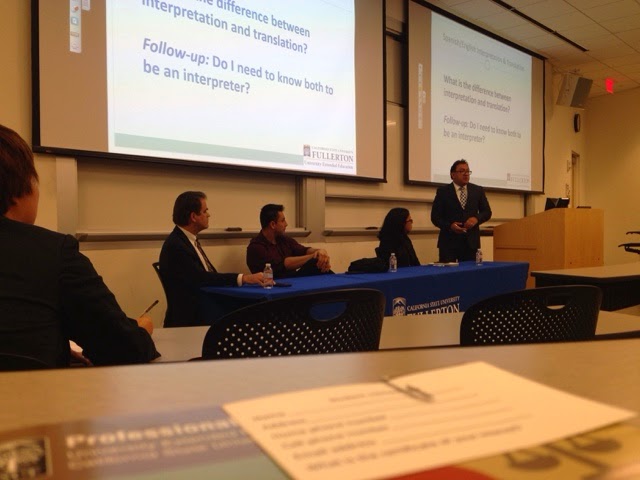
        Earlier this month, one the interpreters I have shadowed for my mentorship, Edna, was invited to be on a panel of interpreters at the new student orientation of Cal State Fullerton's interpreting program. I got to participate in the orientation and get a feel for what the program is like as well as learn from the other interpreters who were there. I enjoyed learning about the program, which has two tracks: healthcare or court interpreting. At the end of the program, students will be prepared to take the exam for court certification or healthcare interpreting. All the instructors are working professionals and classes focus on practice. Based on what I heard at the orientation I went to, I think this program is something I might consider doing in the future.


The panel of interpreters. Edna is on the right.


Wednesday, February 18, 2015

Blog 16: EQ Answer 2

1. What is your EQ?
        How can an interpreter best ensure understanding between people who do not speak the same language?

2. What is your first answer?
       By possessing a high level of fluency in both the source and target languages, an interpreter can best ensure understanding.

3. What is your second answer?
        By possessing a thorough knowledge of the culture behind both the source and target language, an interpreter can best ensure understanding.

4. List three reasons that your second answer is true, with a real-world application for each.

  • Words or phrases that may not be offensive to one culture may be to another. Interpreting something literally because it was not thought to be insulting by the interpreter can result in unnecessary confusion and conflict.
  • Every culture has different ways of addressing certain people. For example, Japanese is a very formal and respectful language while English is more casual toward people, even elders. An interpreter must be aware of these for both languages being spoken.
  • As an interpreter, knowing about the culture of a language involves informing oneself on different aspects of the country that the language is from (e.g. socioeconomic, political, religious) so that there is a context for what is being said by the speaker, which helps in conveying meaning.
5. What printed source best supports your second answer?
        McCarthy, Jane, Irene Cassidy, Margaret M Graham, and Dympna Tuohy. "Conversations Through Barriers of Language and Interpretation." British Journal of Nursing (Mark Allen Publishing), 22.6 (2013): 335-339.

6. What other source supports your second answer?
        Collectively, the three interviews I have conducted with professional interpreters.

7. Give a concluding thought. 
         Understanding the culture of a language is essential to understanding the language and what is meant by the speaker. An interpreter must be aware of cultural contexts and nuances in order for his or her listeners to fully grasp the intent of the speaker in a way they will understand. That's why I picked culture as one of my EQ answers.

Tuesday, February 10, 2015

Blog 15: Independent Component 2 Approval

1. Describe in detail what you plan to do for 30 hours.
        My 30 hours will consist of meeting separately with two people I know, one who is fluent in Spanish and one who is fluent in Chinese. These meetings will basically consist of hanging out and conversing in each person's respective mother tongue. In addition to practicing the language, I will also be able to get some insight on the culture of each person's native country and how their language relates to it.

2. Discuss how or what you will do to meet the expectation of showing 30 hours of evidence.
        To show evidence for my component, I will take pictures with the two people I meet with and any activities I do with them. I will also type up something for each person to sign verifying the number of hours I spent talking with them.

3. Explain how this component will help you explore your topic more in depth. 
        There are two main was that my independent component will help me explore interpretation more in depth. The first is that through practicing speaking Chinese and Spanish I will gain a better perspective on my first EQ answer, which is regarding language fluency. Since one must be fluent in a second language in order to becoming an interpreter, I feel that learning and practicing with native speakers I am acquainted with will be very beneficial to me both in my project and in general. The second way my component will deepen my exploration of my project is that by spending time talking with people who are actually from and have lived in Chinese and Spanish-speaking countries, I will be able to learn about the culture behind the two languages. This relates to what I am planning for my second EQ answer, which is that interpreters must have a thorough knowledge of the culture of both languages in order to best ensure understanding.

4. Update your senior project hours log.
        Done.

Friday, February 6, 2015

Blog 14: Independent Component 1

Literal
  • I, Claire Dix, affirm that I completed my independent component, which represents 80 hours and 30 minutes of work.
  • The sources I used to help me complete my independent component were, Integrated Chinese Textbook Level 1, Integrated Chinese Workbook Level 1, and El Mundo 21 Hispano. 


  • My senior project hours log has been updated.
  • For my independent component, I took two college level language courses, Spanish for Spanish  Speakers II (Spanish 250) at Cal Poly Pomona, and Beginning Chinese (Chinese 101) at Citrus College. I recorded hours for both classes from the time my component was approved in October to when they ended in December.
Interpretive
        For obvious reasons, it is simply not possible to be an interpreter without having being able to speak more than one language. Taking these classes was significant to my project because knowing a language other than one's mother tongue is basically what both my project and career hinge on. In addition to this, taking these courses tied into my first EQ answer, which is regarding fluency in both languages involved in the interpreting happening at the time. Knowing not only the grammar, but also the cultural aspects of a language is essential to interpreting, and both classes integrated their respective language's culture into the class. I felt that they both started me on a strong path to fully acquiring Spanish and Chinese in the future. So even though my independent component was not about interpretation itself, it did deal with a directly related, critical element of it.
        I only recorded in my IC1 log the hours that I was physically sitting in class, which totaled 80.5 hours. I received a B grade in both classes, however I believe this is in no way evidence that I did not go above and beyond the 30 necessary hours as recorded in my log nor that I did not put my best effort into either class. I missed one Chinese class and no Spanish classes. Just being in class and participating got me the number of hours I needed to complete the requirement for this component; I didn't even count additional time for homework, projects, and studying, although that alone would probably have added up to over 30 hours as well.
        Here is a link to my Cal Poly Spanish Transcript. Here is a link to my Citrus College Chinese Transcript.

Spanish Work

I took notes every day off of what the professor wrote on the board

Here are some typical Spanish homework assignments -
writing a paragraph about a class discussion topic.
This is the first page of my Spanish midterm.
My score is at the top. Part of it was writing a composition
on the themes of a movie we watched in class. Mine is on
the right.


Chinese Work Unfortunately, my Chinese professor did not allow us to keep any tests or quizzes.

We did these character worksheets at the
beginning of each new lesson

This a Chinese crossword we did as a class with t
he vocab we were learning at the time.

Chinese homework came out of the
workbook. There was a lot of reading, writing,
 and answering questions. On the right page I had to
read the Chinese paragraph and answer the
comprehension questions.


This is my group's final Chinese project, a video about the 
green onion pancake, a popular dish in China. 
Applied
        Through my independent component, I learned how difficult it is to learn a new language even to the point where one is able to have a decent conversation with another person. This was especially evident to me in considering my Chinese class. Unlike Spanish, where I am at an intermediate level, I went into the first day of Chinese knowing how to say literally three words and absolutely nothing about how to read it, write it, or how anyone made sense of the random sounds I heard when I heard someone speak it. It was only through extremely hard work and self motivation that I was able to comprehend or speak anything. At the end of the class I was very excited at my progress. Learning Chinese is one of the most enthralling and exhilarating things I have done in my life. That being said, the process of learning it was HARD. Very hard. I was lost and frustrated at several points in the process of both classes, which is probably why I ended up with Bs. However this gave me a greater realization of how much interpreters are needed. As I have concluded previously in my presentations and interviews, the purpose of interpreting is understanding between people. Through the classes I took, I saw that learning any new language, especially one like Mandarin, is most definitely not for everyone. But that's why interpreters work (and I worked, in my classes) so hard at it. It's so that one person can comprehend what another person is trying to convey to them without having to spend a decade studying characters and tones. Because even though I love it, I know not everyone does.